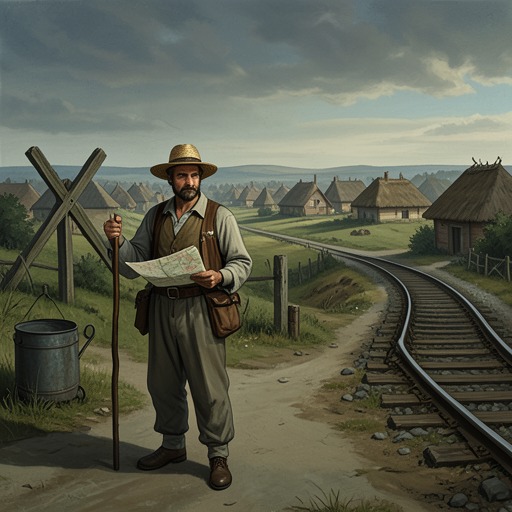
Antek’s attempted departure from Lipce
The PeasantsAntek’s attempted departure from Lipce turns a practical search for work into a passage governed by poverty, resentment, and a sudden encounter with Jagusia. He leaves Hanka and Weronka weeping at the cottage, but the road does not carry him cleanly away from the life he means to escape: a passing sleigh bearing Maciej Boryna and Jagusia arrests him, and at Jankiel’s inn the sight of her eyes returns with such force that he bolts for the door. The episode ends with him running out, not with any confirmed journey to work.
Causes and Decision
The immediate pressure is economic. Hanka cries that the household has been reduced to the condition of the poorest hired hands, with no milk or comfort, and grieves that Antek has sold the last cow her father gave her. Her lament is both about hunger and about the ruin of a household for which she says she has labored hard. Antek answers by pushing money toward her, telling her to pay what is owed, buy what she needs, and put the remainder away. He keeps five rouble notes in his wallet. The exchange makes his departure materially complicated: he is leaving a family in want, but he does not leave them without the money he has just handed over.
When Hanka asks what he needs so much money for, Antek says he will not set out with only a staff. Asked where he is going, he answers that he is leaving to look for work and will not stay there to rot. His language turns unemployment and deprivation into a larger sense of confinement. He insists that he will not work for peasants in Lipce and says he would rather wither than remain in the same conditions. Hanka protests that a poor man encounters the same wind everywhere and asks whether she is to be left alone. Her appeal does not change his decision.
Antek explains that he will try at the manors, asking about service and perhaps taking hired work from Yuletide if necessary. The plan is provisional in its details but firm in its refusal to stay. He says he can no longer endure the wrongs continually before his eyes, the pity and sidelong looks that make him feel like a mangy dog. His anger, then, is not simply directed at low wages: he wants distance from the people and memories that keep his grievances present. He says he will go wherever his nose leads him, as far and as quickly as possible.
The Break at the Cottage
Hanka freezes at the unfamiliar intensity of his outburst. Antek tells her goodbye and says he will return in a few days, but when she asks for a kind word, he dismisses affection as something not on his mind, slams the door, and leaves. The bluntness gives the departure the force of a domestic severing, even as his stated intention is temporary. Hanka remains at the front of the cottage, convulsed with weeping, while Weronka watches from the window.
Outside, Antek whistles and walks briskly, leaning on his staff as the snow crunches underfoot. He complains to himself about Hanka’s crying, yet his movement soon takes on a momentum beyond the argument. Looking over the frosted whiteness, he feels an unexpected longing for other villages, new people, and another life. The narration compares the impulse to a flood sweeping away a frail shrub: it has come suddenly, and he feels unable either to resist it or to turn back. He had not been thinking of leaving even an hour earlier. The desire to get away, whether or not wages await him, seems to arrive from outside his deliberation and carry him forward.
At the poplar-road turning, Antek hesitates and looks over fields lost in mist. He is chilled, shivering, and unsure where to go first. He chooses to pass through the village and take the road behind the mill. That choice briefly makes his departure seem like a route with a destination; the sleigh that bears down on him interrupts it before he has gone half a staje.
The Sleigh on the Snowy Road
Maciej Boryna is driving the sleigh, urging the horses with his whip, talking and laughing as they fly along. Jagusia is with him and speaking loudly until she spots Antek. Their eyes meet for a split second. The sleigh continues past, and the encounter is over almost before it begins, but Antek stands motionless, watching it disappear into the snow.
The scene is rendered through what remains after the sleigh has passed: the flash of Jagusia’s red skirts and the bells fading into the white road beneath frost-covered branches. Antek continues to see her eyes, startled and sorry, astonished and joyful at once. The narration makes the brief look the episode’s emotional reversal. A moment earlier he had imagined other villages and a different life; now the eyes he has just glimpsed occupy his attention so completely that he hangs his head and trudges on, turning back repeatedly though the sleigh is gone.
The encounter does not produce a conversation or a change in the stated plan. Instead, it unsettles Antek from within. His memories slip away, and he cannot tell where he is going or what has happened; the narration describes him as sunk in a waking dream. The contrast is sharp: he set out to escape the past, but a fleeting sight of Jagusia makes that past more vivid than the snowy road ahead.
Jankiel’s Inn and the Interrupted Escape
Antek later sits drinking at Jankiel’s inn, which is mostly empty and quiet. The sun has passed its highest point, frost has taken hold, and the sleigh runners creak outside. He drinks slowly and seems absorbed in thought, largely unaware of the activity around him. The progression of the drinks gives the scene a measured rhythm: after a quart and then another, Jagusia’s blue eyes still shine before him, close enough, in his perception, almost to touch. After a third, they seem to circle and sway around the inn like flickering lights.
The vision is not presented as a new encounter with Jagusia but as the persistence of the road-side glimpse in Antek’s mind. Frightened by what he sees, he springs up and slams the bottle against the table, breaking it, then makes for the door. Jankiel blocks him and demands payment, refusing to extend credit. Antek threatens him so violently that Jankiel pales and steps aside; Antek crashes through the door and runs out.
The episode therefore gives no confirmation that Antek reaches a manor, finds service, or begins hired work. His declaration of departure is real, and he does leave the cottage and continue as far as the inn, but the narrative closes on a flight prompted by the sight that has haunted him, not on a settled new life. The movement away from Lipce is repeatedly checked by attachment: first by Hanka’s grief at the cottage, then by Jagusia’s passing glance, and finally by the eyes that return in the inn. What began as an effort to escape humiliation and memory becomes, before any destination is secured, another demonstration of how strongly those ties still hold him.